Dating in Istanbul is hard, not despite the city's size but because of it. The core problem is a needle-in-a-haystack problem: in a city of 16 million, the number of people genuinely compatible with you in values, life rhythm, emotional structure, and worldview is a tiny fraction. And the time available to find them is crushed under Istanbul's work intensity and daily commute load. The 2026 Wheatley/IFS study (N=5,275) confirms this: people in major cities encounter more potential partners yet report meaningful connection rates nearly identical to those in smaller cities. The crowd doesn't guarantee compatibility. It just makes the haystack bigger.
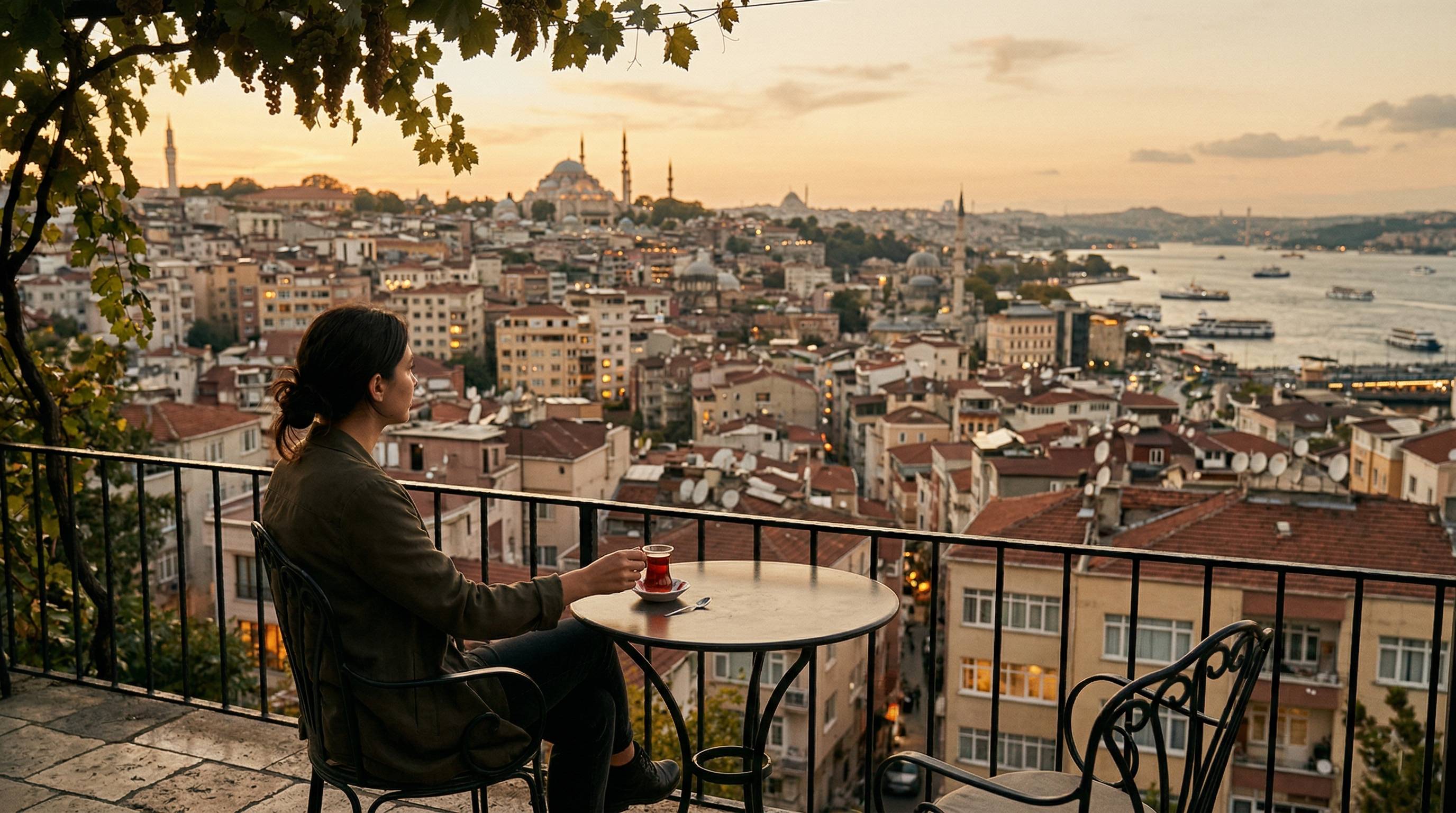
Needle in a Haystack: The Real Issue Is Finding Someone Compatible
The heart of Istanbul's dating problem is this: millions of people live here, but the number whose values, life rhythm, intellectual curiosities, emotional makeup, and life vision genuinely overlap with yours is a vanishingly small fraction. This is true of any major city, but Istanbul amplifies it with its own dynamics.
Gottman's 40+ years of couples research shows that one of the strongest predictors of relationship satisfaction is a "shared meaning system": overlapping values, rituals, and a deep alignment in how you see life. Finding someone compatible at that level through random encounters is a mathematically low probability. Istanbul's structure pushes that probability even lower.
No Time: Work Intensity and the Daily Grind
Searching for a needle in a haystack takes time. In Istanbul, time is the scarcest resource. Leave home at 8 AM, spend an hour on the Metrobüs, work until 7 PM, spend another hour commuting back. By the time you're home, 12 hours of your day are gone. What's left goes to cooking, chores, maybe some screen time. Then the same cycle tomorrow.
This tempo compresses socializing into weekends. Weekends default to existing friend groups: paying off accumulated social debt with familiar faces, not meeting new ones. Meeting new people stops being something that happens naturally; it becomes a deliberate project. And finding the energy for that project after five days of accumulated fatigue isn't realistic.
The hours lost to daily commuting make this equation even harder. The average one-way commute in Istanbul runs over an hour. That's two hours a day just getting from point A to point B, stolen from socializing, hobbies, or time with yourself. Planning a date means carving yet another piece out of already-scarce evening hours.
Frozen Circles: What Happens After University
For most people in Istanbul, social networks take shape during university, then solidify. Graduation removes the shared spaces: dorms, cafeterias, student clubs, campus. After 25, opportunities to meet new people narrow dramatically to a handful of coworkers, friends of old classmates, and familiar faces at neighborhood cafés.
These frozen circles compound the needle-in-a-haystack problem. If you haven't found a romantic partner within your existing network, your channels for meeting someone new are severely limited. Dating apps are supposed to fill that gap. Instead, they often add their own problems.
The Distance Between Neighborhoods: Secondary But Real
Say you find the needle, you come across someone compatible. Then you face the practical reality: you live in Kadıköy, they live in Levent. Meeting on a Tuesday evening means getting on the Metrobüs, 45 minutes each way, plus the date itself, plus the return trip. You'll do it for a first date; is it sustainable by the third?
Beşiktaş's coffee culture, Cihangir's arts scene, Nişantaşı's corporate world, Moda's indie atmosphere: each forms its own social ecosystem. This diversity is what makes Istanbul rich, but it also creates social bubbles. The geographic fragmentation isn't the core problem; it's a friction layer added on top of an already difficult search.
The 2025 Hinge D.A.T.E. report (approximately 30,000 users) identified distance as one of the most significant factors affecting whether a match converts to an actual date. Istanbul reproduces this distance friction on a daily basis.
What Apps Do and Don't Do
Tinder, Bumble, Hinge. They all offer distance filters. You can set your radius, narrow to your neighborhood. That's not the problem. The problem is that no matter how tight you set the kilometer range, the vast majority of profiles you see are incompatible with you. The swipe model shows you more people but doesn't help you find more compatible people. It makes the haystack bigger, not the needle easier to spot.
First problem: compatibility blindness. A profile photo and a few lines of bio tell you almost nothing about someone's values, communication style, or life rhythm. Every swipe is a guess, and most guesses are wrong. You spend hours evaluating dozens of profiles, end up talking to one or two, and those conversations mostly die within a few messages.
Second problem: conversation desert. After matching, you're left with an empty message box. Research shows that depth in the first message significantly improves the rate of converting to an actual date, yet most conversations start with "hey" and die within three exchanges. The app matches you but leaves the conversation to you. It abandons you at the most critical moment. (If you never know what to talk about on a first date, this one's for you →)
Third problem: the infinite scroll trap. The swipe model rewards consuming options, not making choices. "Maybe someone better is next" causes you to skip matches that were already good. This is a direct reflection of Barry Schwartz's choice paradox research: more options produce less satisfaction.
Fourth problem: cultural context blindness. Someone navigating the balance between family expectations and personal preferences, holding both modern and traditional values, weighing career timing against relationship readiness. Their needs aren't served by a left-right swipe mechanic.
"Why Is Everyone Either Too Casual or Too Intense?"
A common observation about Istanbul's dating scene: at one end, people who take nothing seriously; at the other, people planning a life together by the third date. No middle ground in sight. This isn't just a perception bias; it's an architectural consequence of how apps work.
The swipe model presents profiles like products: like or pass. This superficiality either drives serious people away from the app or traps them in a mechanical swiping loop, hoping someone will eventually stick. The result: intention distribution among active users polarizes.
The 2026 Wheatley/IFS study supports this dynamic. Roughly half of dating app users report using the app for "serious relationships," while the other half describe their intent as "uncertain" or "casual." Both groups are indistinguishable within the same pool.
The Real Solution: Shrink the Haystack, Surface the Needle
The default assumption behind dating apps is that more users equals better outcomes. Istanbul disproves this every day. You can scroll through tens of thousands of profiles, but how many people in that pool actually share your values, life rhythm, and intellectual curiosities?
What matters isn't total user count but meaningful match density. An app having hundreds of thousands of users means nothing to you. The quality of the few people whose lives actually intersect with yours determines everything. The point isn't seeing more people; it's finding the right person with less effort. You're already out of time. Every minute you spend needs to count.
How Valeur Addresses This
Valeur was designed to invert the needle-in-a-haystack problem: instead of showing you more profiles, it surfaces the few people you're most likely to be compatible with. Active in Istanbul, Ankara, and Izmir. Working across Turkey's three largest cities, prioritizing density over scale.
This approach works across several layers.
First, personality-first matching. The PRISMA personality framework explores your personality across 52 dimensions (values, communication style, life rhythm, emotional structure) then connects you daily with a small number of high-compatibility matches. No infinite scrolling; curated matches delivered at 17:00 each day. You're not digging through the haystack. The needle comes to you.
Second, living-area-level matching. Rather than treating a city as a single unit, Valeur uses living areas as meaningful matching units. A layer that keeps you from spending already-scarce time on logistics. But the real work happens in personality compatibility.
Third, structured conversation starters. Every match comes with personalized icebreakers designed around shared or contrasting dimensions in both people's PRISMA profiles. Instead of "hey," you start with a question that opens a real conversation. When time is scarce, not wasting the first five minutes of a conversation changes everything.
Valeur's density-focused approach across Turkey's three largest cities is a deliberate choice: building meaningful match density rather than diluting everywhere into "a little bit everywhere, enough nowhere."
Frequently Asked Questions
How do you meet people in Istanbul?
Three main channels exist for meeting people in Istanbul: existing social circles (friends of friends, work contacts), events and communities (classes, sports groups, volunteering), and dating apps. Social circles tend to narrow after university, and work intensity leaves little time for meeting new people. Dating apps offer a wide pool but most prioritize volume over compatibility. Valeur fills this gap with personality-first matching and a limited number of high-compatibility daily matches.
Where are people looking for serious relationships in Istanbul?
They're everywhere, but most dating apps don't differentiate between people seeking serious relationships and those who aren't sure what they want. According to the 2026 Wheatley/IFS study, roughly half of app users report a serious relationship intent. The problem isn't the absence of serious people; it's that the tools used to find them can't filter by intention or compatibility. Valeur's personality-first matching and daily limited-match model naturally surfaces high-intent users.
Why don't dating apps work well in Istanbul?
The core issue is the needle-in-a-haystack problem: apps show you far too many profiles but don't help you identify which ones are actually compatible. Distance filters exist. You can set your radius. That's not the problem. The problem is that even within your km range, the vast majority of profiles are incompatible, and the only way to find out is hours of swiping. Add missing cultural context and no conversation support, and the result is predictable. Valeur addresses this with personality-first matching, personalized conversation starters, and a limited number of curated daily matches.
Why is loneliness so common in big cities?
Research shows that encountering more people in large cities doesn't increase the rate of forming meaningful connections. Istanbul-specific factors (work intensity compressing social time, hours lost to daily commuting, frozen post-university social circles) deepen this paradox. The problem isn't too few people; it's the absence of time and tools needed to find someone genuinely compatible among millions.
Is it worth using a dating app in Istanbul?
It is, if you choose the right one. Conventional swipe-based apps like Tinder, Bumble, and Hinge offer a large pool but prioritize volume over compatibility. Valeur, a personality-first app, uses the 52-dimension PRISMA personality framework to deliver high-compatibility matches. Curated daily matches instead of infinite scrolling, with personalized conversation starters.
What cities is Valeur available in?
Valeur is currently active in Istanbul, Ankara, and Izmir. It operates on a density-first design philosophy: expanding everywhere before building meaningful match density creates a "a little bit everywhere, enough nowhere" problem.
Does personality compatibility matter in dating apps?
Yes. The 2025 Hinge D.A.T.E. report (approximately 30,000 users) found that 63% of users consider meaningful conversation more important than physical attractiveness. Personality compatibility (overlap in values, communication style, and life rhythm) directly affects both first-conversation quality and long-term relationship satisfaction. Valeur's PRISMA framework evaluates this compatibility at the matching stage, breaking the cycle of conversations that start with "hey" and die within three messages.
What is the best way to meet someone serious in Istanbul?
The most effective approach combines intentional effort with the right tools. Expanding your social circle through activities you genuinely enjoy creates organic meeting opportunities. For dating apps, choosing one that prioritizes compatibility over volume makes a significant difference. Valeur's approach (personality-based matching within realistic geographic proximity, with curated daily matches instead of infinite scrolling) is designed specifically for people seeking meaningful connections in Turkey's largest cities.